Ella Britten-Jones
Selected work — VESSEL / product case study
A real product followed from customer observation into physical development
Nearly four years at MECCA — listening to what customers asked for and watching how they actually lived — surfaced the same unserved need repeatedly. That pattern became VESSEL.
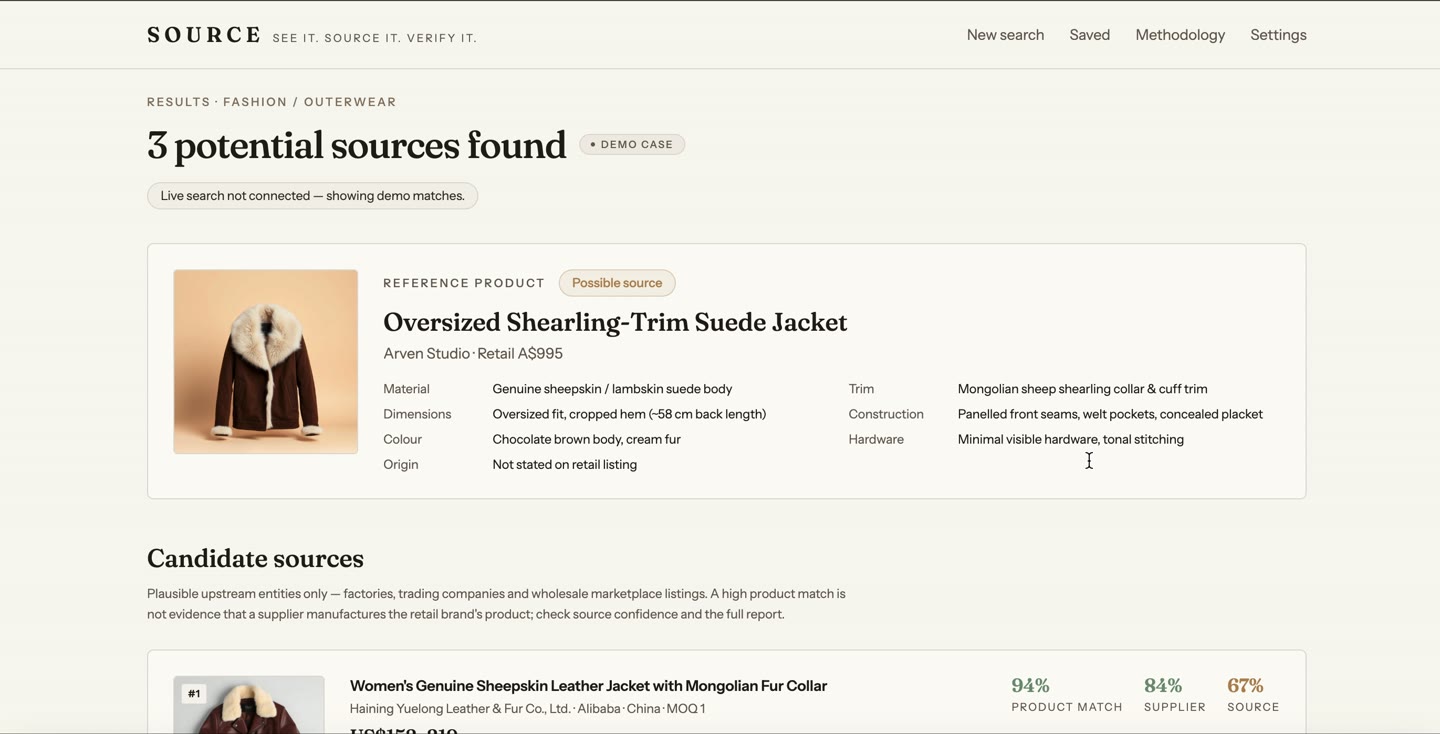
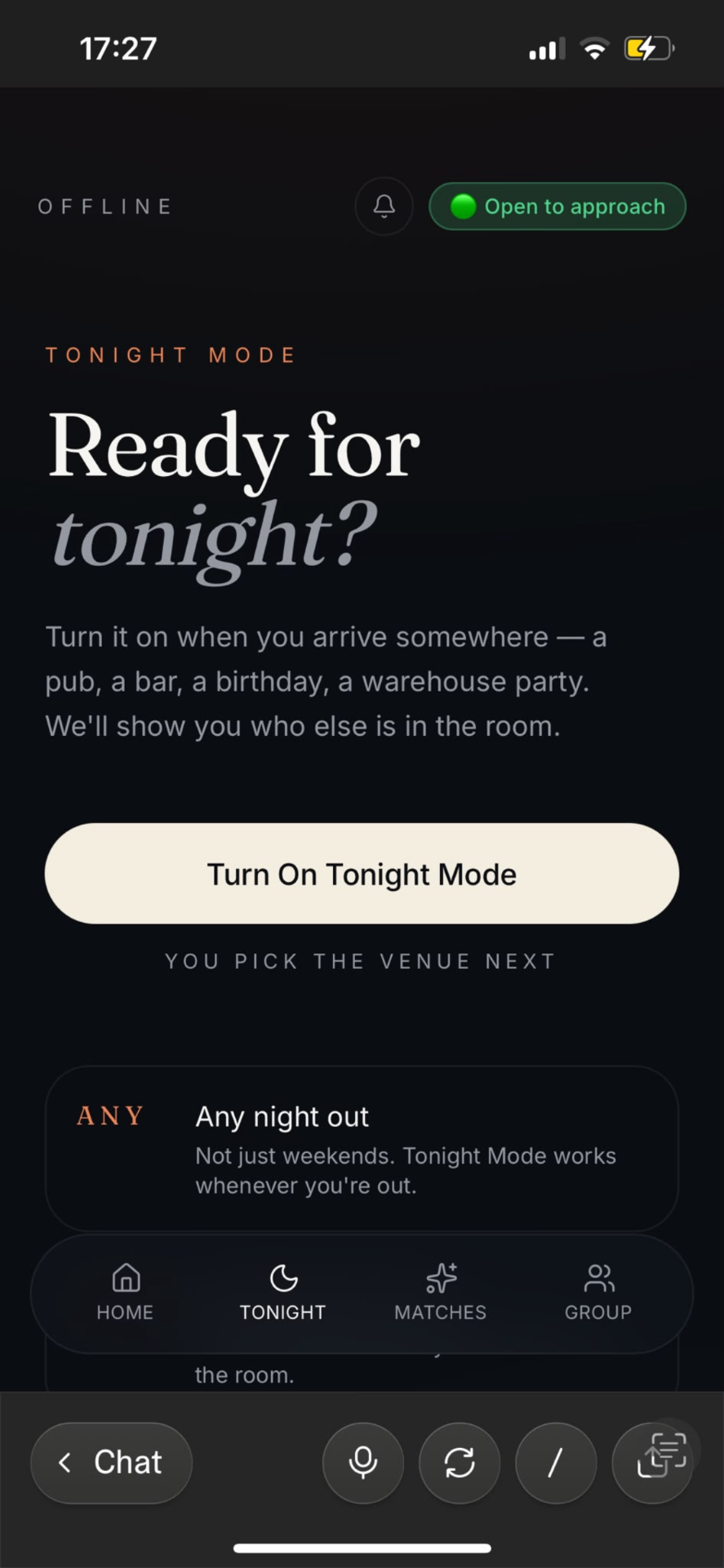
VESSEL is now at physical sample stage. Two additional software prototypes — Relay and OFFLINE — explore different behavioural problems.
Observed at MECCA, Sydney
Two customers, on two consecutive days, arrived at the same unsolved problem from opposite directions. Neither of them met. I served both.
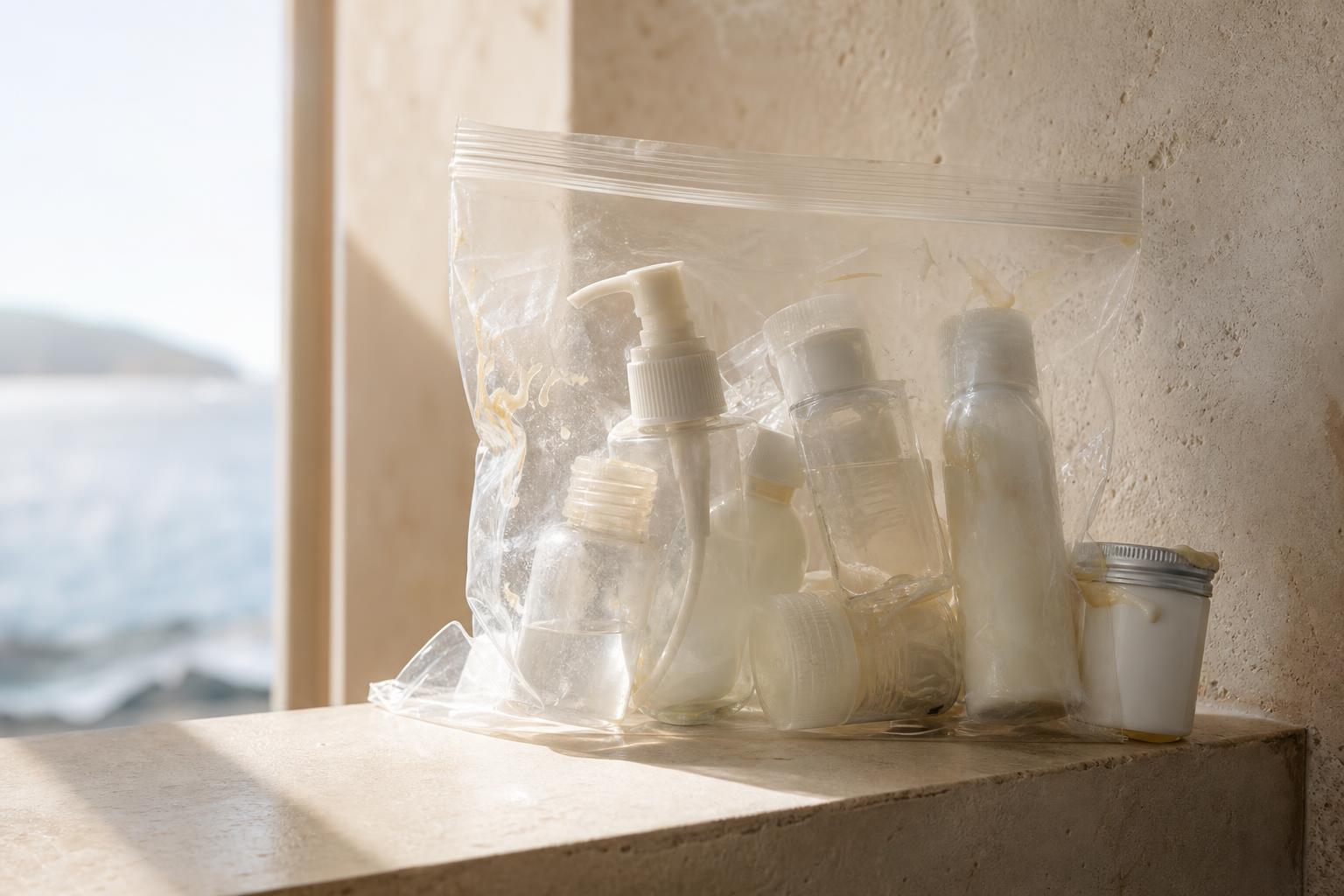
The first was preparing for three weeks abroad. Weight-conscious and methodical, she wanted her existing routine in travel format and found, brand by brand, that it did not exist. Her SPF was a dropper serum. She rejected supermarket decanting bottles because they leaked and because a squeeze top cannot reproduce a pipette. She left with a set of travel minis that were not the products she uses. What she needed was format-specific refillable containers.
The next day a man came in to replace a cleanser airport security had confiscated in Europe for exceeding the carry-on limit. He could not have told you the capacity of the bottle he lost. What he needed was carry-on compliance communicated on the container itself.
Two customers could have been an anecdote. Over the following months I served the same two behaviours repeatedly: people quietly abandoning the products whose application method could not be reproduced, and people guessing at capacity until something was taken off them. Neither group ever described a problem with travel bottles. Both were adapting their behaviour around one.
The dependency underneath both patterns is the same. A travel routine only survives if the container preserves the way the product is applied, and if carry-on compliance can be verified at a glance. Every existing option failed at least one of those.
That became VESSEL.
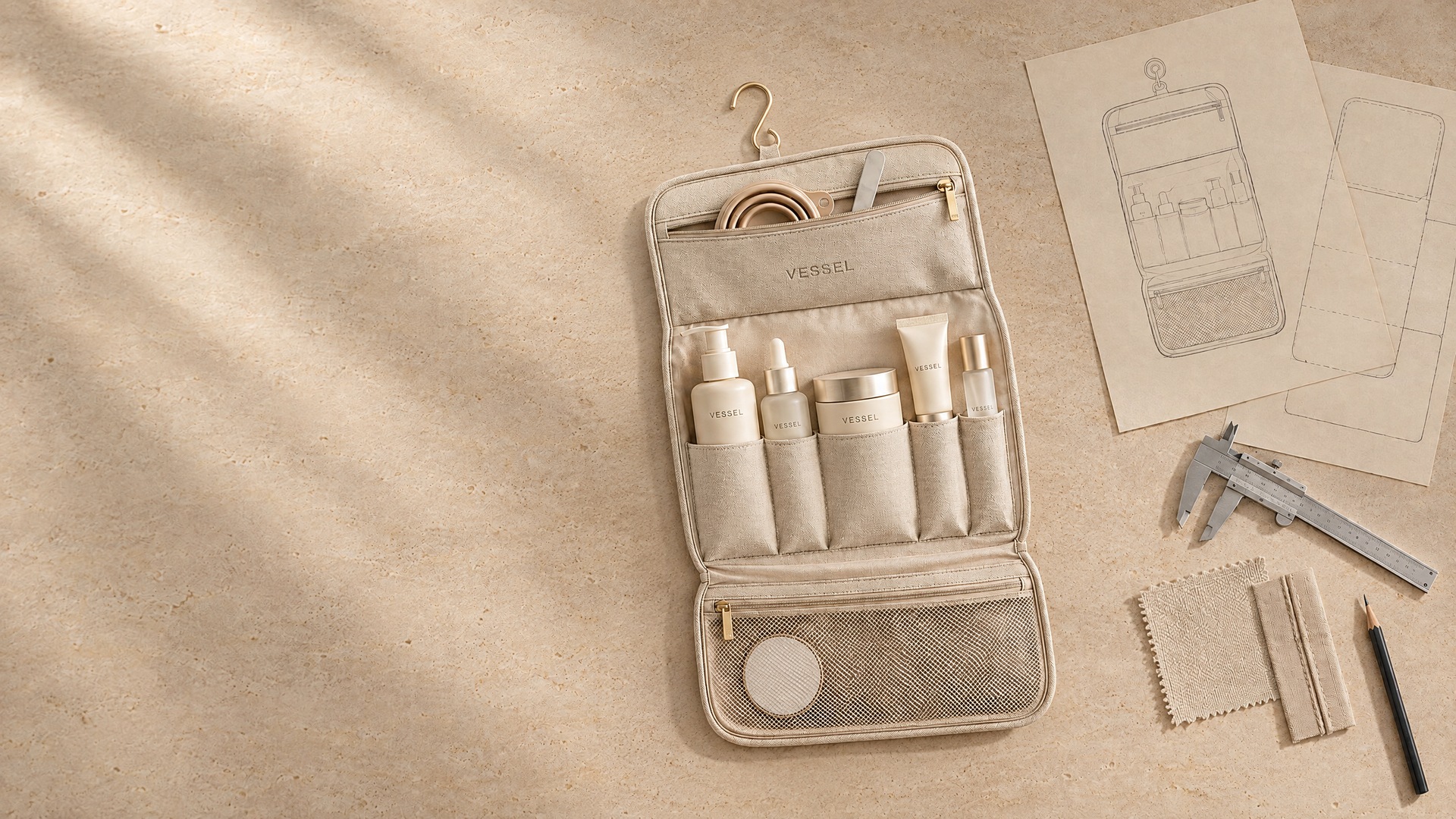
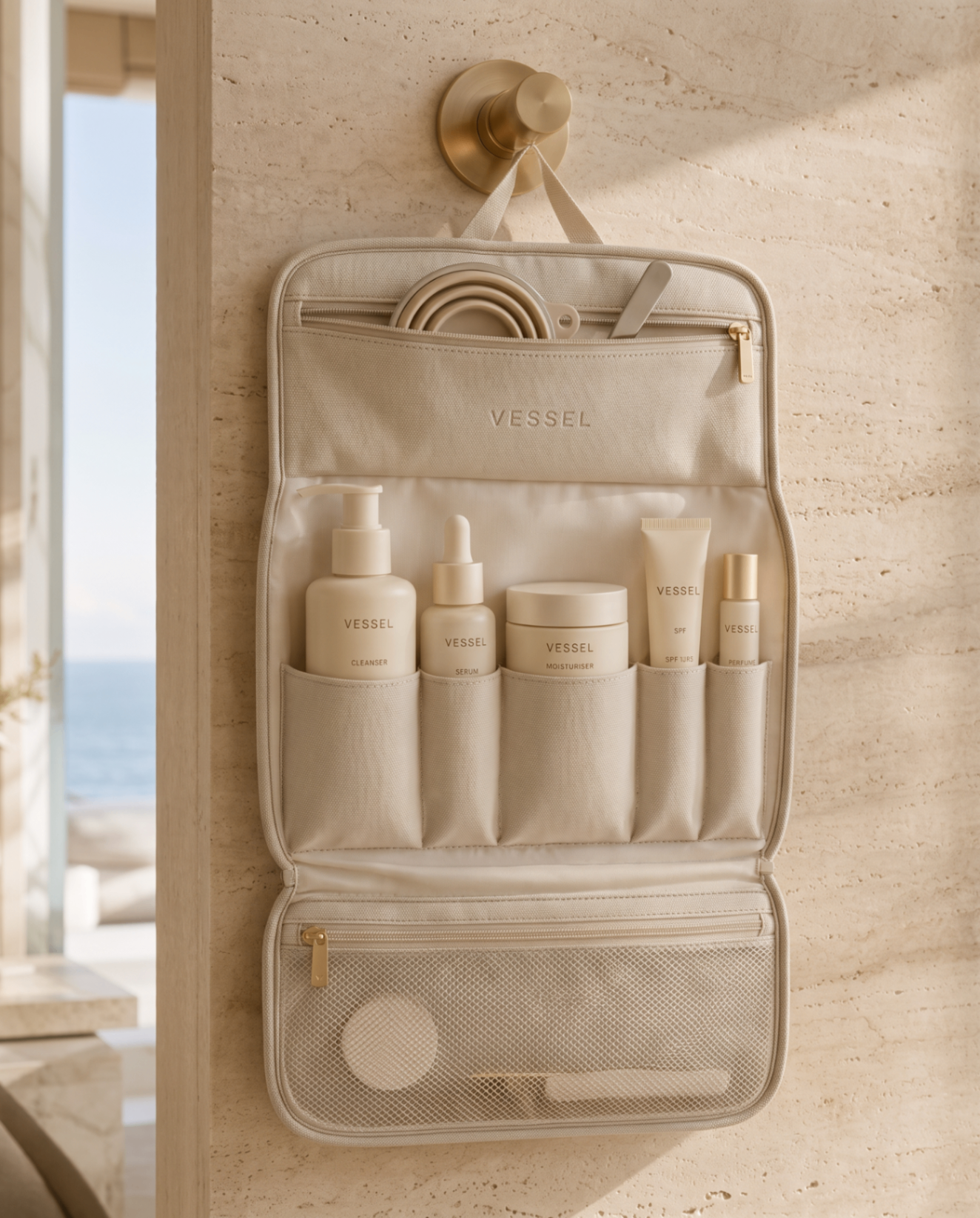
A hanging travel skincare system that reproduces the routine people already trust.
It lets travellers take the products they already use instead of replacing their routine with whatever happens to be available in travel size.
Reusable decanting tools. Carry-on capacities printed on every container. One purchase. Nothing sold separately.

The rest of this case study is how that idea became a manufactured product.
March 2026 – present. Solo.
Claim, artefact, status. Also built: Relay and OFFLINE — two software prototypes from different behavioural problems.
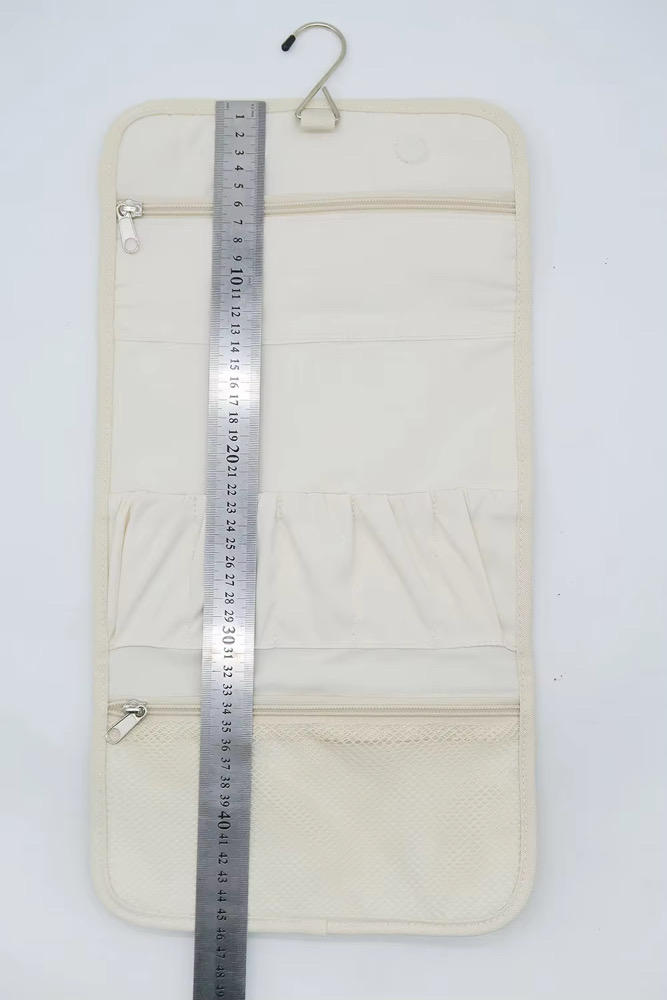
Inspection photographs from the factory sample run. Documentary, not product photography: rulers left in frame, finish flaws left visible.

Opened and hung as it would be used. The hanging architecture held under load, exactly as specified.

Measured against the documented dimensions rather than against the render. Where the sample sat outside specification, it was recorded against the tolerance table in v7.0.
The specification was correct. Parts of the first physical sample were manufactured outside it, and inspection identified those non-conformances against the documented dimensions.
Reviewing the inspection produced a second, separate finding. The tolerance methodology needed to distinguish more deliberately between dimensions that are function-critical and dimensions where normal manufacturing variation can be accommodated without affecting product performance. The design intent did not change; the way acceptable variation is defined and evaluated did.
Standing rule since: no correction is communicated to a manufacturer until physical measurement confirms the deviation.
Qualitative conversations about what people actually pack surfaced a distinction I had not designed for. Skincare travels together happily. A used toothbrush and a wet razor do not belong in that space, and toothpaste is handled separately again — bought at the destination, or forgotten.
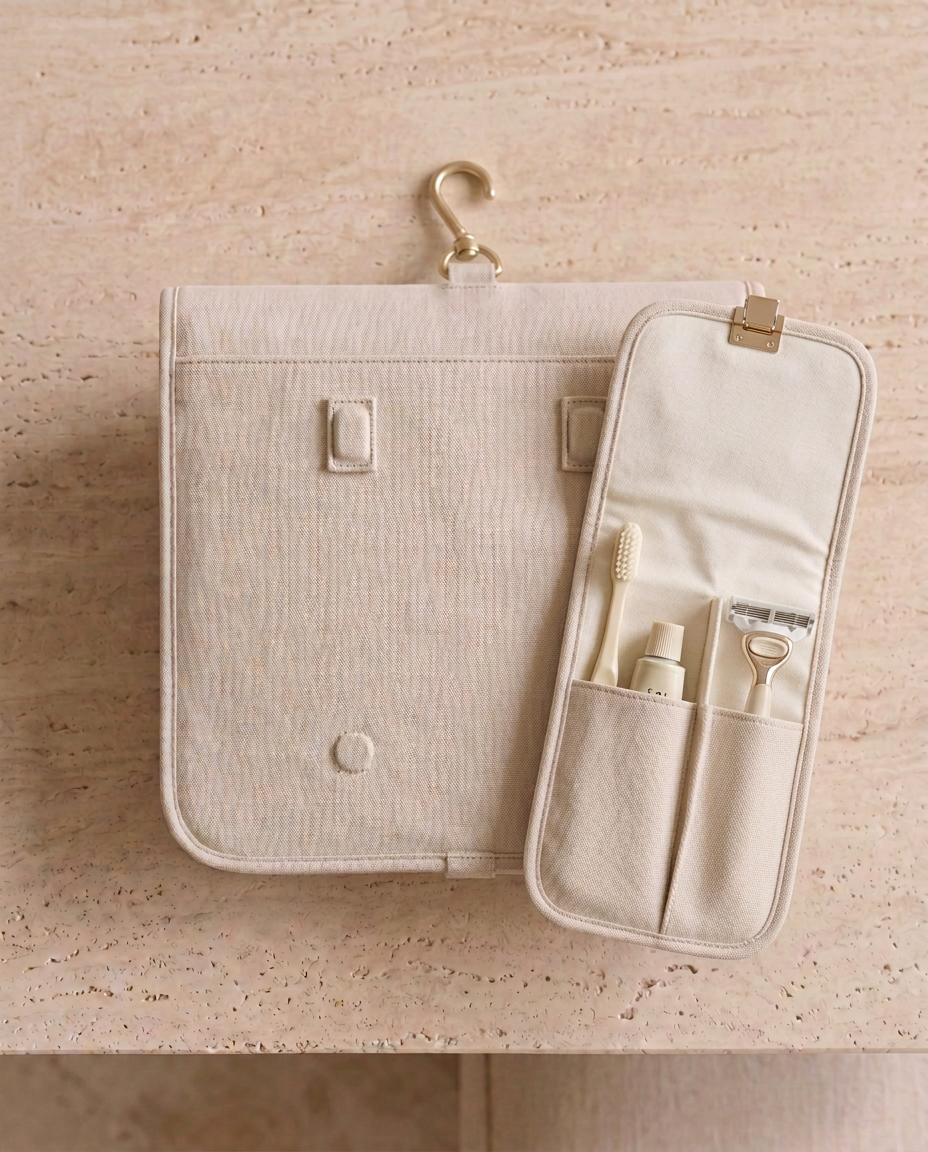
The timing differs too. The primary skincare system can be packed days in advance, while the detachable hygiene pouch clips on immediately before departure, after the user has showered and brushed their teeth. That sequence is the behavioural insight.
The response is now in manufacture: a waterproof detachable pouch with dedicated toothbrush, toothpaste and razor areas, clipping onto VESSEL after the rest of the system is already packed.

A behavioural insight is worth nothing until a factory in another country can build to it without me in the room.
Three representative pages from a thirty-section document: what cannot be compromised, how variation is controlled, how the finished object is judged. Each was selected because it demonstrates a different engineering judgement rather than another example of technical documentation.
Separating the dimensions that decide whether the product works from the ones that only affect appearance, so a factory under time pressure knows which numbers may never be traded away.
Tolerance direction set per pocket rather than one figure across all five, so variation is allowed where it cannot affect performance and closed down where it can. This is the methodology the first sample inspection sharpened.
Acceptance defined as customer behaviour — bottles retained when inverted, hook loaded, pockets reachable one-handed — rather than as dimensional conformance alone.
The wrong build drawn beside the right one, because a specification that only describes success leaves the failure mode available.
A stepped pocket wall for the moisturiser format, specified after measuring the production jar rather than a proxy.
Every brand in the audit sells a container or a compartment. None of them address the failure that actually stops the purchase: a pipette serum cannot survive a squeeze bottle, and a routine that cannot be reproduced is a routine that gets left at home. Naming the mechanism rather than the benefit is what made the language uncontested — and it is defensible because occupying it requires a product decision, not a copy decision.
A travel skincare system that lets you apply your routine the same way you do at home.
Premium 5-pocket organiser
Five containers. Five places.
The first sells a bag. The second describes what happens when you open it.
The audit exists to answer one question: which customer failure is nobody solving? Every brand was read site by site, then scored against two axis definitions written before any brand was placed.4
Positions are my own qualitative assessment from a site-by-site copy and product audit of ten brands, not third-party data.
The unoccupied area of the map: high system integration and high brand restraint together.
Hover or tap any point
Ella's analysis, not independent market research. Positions are my reading of each brand's public product range and site copy as at August 2026, scored against the two definitions above. Another analyst applying the same definitions would place some brands differently.
Travel skincare is growing at 10.8% CAGR — nearly double the 6.2% CAGR of the general travel bag category it sits inside (Grand View Research; Strategic Assessment, Apr 2026).
Decision it supported: building a skincare-application system (pump, dropper, jar, tube, vial) rather than a generic hanging organiser.
Australian women spend an average of AUD $3,600 a year on beauty products (Mordor Intelligence, 2024) — roughly $300 a month.
Decision it supported: pricing VESSEL at $149, close to one month's routine spend rather than a discretionary luxury multiple of it.
Cadence, the closest capsule-based competitor, requires USD $76–120+ in capsules plus a separate $65 case plus $48+ in adapters — often exceeding $200 total for a non-hanging system in one container format (Deep Research & Strategy, May 2026).
Decision it supported: holding VESSEL at AUD $149 all-inclusive rather than pricing below the category leader's effective total cost.
| Brand | Product type | Format matches application method | Transport-only vs full-routine | Price band (USD) |
|---|---|---|---|---|
| Bagsmart | Generic hanging organiser | No | Transport-only | $15–$35 |
| Calpak | Hanging bag, retractable hook | No — generic pouches | Transport-only | $48–$75 |
| Away | Hanging travel vanity | No | Transport-only | $65–$85 |
| Monos | Hanging toiletry case, loop only | No | Transport-only | $85–$95 |
| Cadence | Capsule system + separate case | No — single capsule format | Attempts full-routine, one format only | $76–$120+ (+$65 case) |
| VESSEL | Complete hanging system, 5 containers | Yes — 5 formats matched | Full-routine, one system | AUD $149 (~USD $95) |
Full ten-brand audit, axis definitions and positioning map remain the primary competitive narrative; this table is supporting evidence, not a replacement. Pricing confirmed against live brand sites, May 2026 (VESSEL Market Intelligence Report). Placements are Ella's analysis from public product and site data, not licensed third-party competitive data.
An adjacent reference point, not a competitor. Cadence reports roughly 500,000 customers and a 50% repeat purchase rate, and describes putting up to 250 prototypes into a new product — evidence that a premium buyer will pay for a considered decant set, and a marker of how much iteration this category takes.
Ella's calculation using Cadence's publicly listed pricing, retrieved August 2026. Individual prices are public; the assembled total is my own definition of an equivalent set.
AI runs through the workflow; judgement governs it. One real pass below: the model returned a confident, internally consistent, wrong answer, and what follows is what I did about it.
Inputs assembled by hand — component quotes, tooling, 3PL, shipping, processing — then a unit economics model requested for a single SKU at $149. It returned a complete, confident answer.
COGS of approximately $38 per unit; contribution margin 58%.
The figure omitted tooling amortisation and the funnel, spatula and mirror inclusions that ship inside the single SKU. It was plausible because it was internally consistent, and wrong because the inputs were incomplete.
I rewrote the inputs rather than asking for a fix, and the second model carried its assumption on its face: COGS approximately $53, contribution margin 41.9%.
Treat every item that ships inside the box as COGS. Amortise tooling across the first production run and state the run size you assumed.
I reset the CAC ceiling myself against the corrected contribution and sensitivity-tested it. The standing rule that came out of it: any model returning a margin better than my hand estimate is treated as an input error until the inputs are re-listed line by line.
Nothing here has run. It is a plan built to be executed by someone other than the person who wrote it, with targets and results kept visibly separate.
Objective. Convert a pre-launch waitlist into a first production run sell-through, without discounting and without a second SKU to hide behind.
Audience. People whose routine represents real investment and who have already been failed by travel format.
Single message. Apply your routine the same way you do at home.
Sequence. Build in public first, waitlist second, four-email sequence third, open fourth. Nothing is promoted before the specification is locked, because a launch date that moves costs more trust than it buys attention.
Make the viewer recognise themselves
Save rate
Make the architecture legible in twenty seconds
Replays and completion
Earn trust before there is a product
Comment depth, not volume
Show the behaviour change, not the object
Shares and direct messages
Founder's unit economics model. Figures represent internal commercial modelling rather than third-party market data. These are planning assumptions, not operating results.5
Single SKU. Nothing sold separately at launch.
After 3PL, shipping and payment processing. Approximately $62.45 per unit.
The threshold the model holds at, sensitivity-tested rather than assumed.
Including tooling amortisation across run one and every in-box inclusion.
Industry growth estimate. Travel accessories overall are estimated at 6.7–7.2%.
Tracked revisions to the manufacturing specification, each one dated and reasoned.
VESSEL is pre-launch and founder-solo. The financial model is a model. There is no CAC, conversion rate or repeat-purchase data yet, and this site does not invent any. Renders on this page are AI-generated concept images and are labelled wherever they appear.
V2 concept. Not manufactured, launched or validated.
V1 controls the containers because skincare has to be decanted. Makeup does not — most of it already arrives in the container it needs, so the constraint moves from decanting to visibility and placement.
V2 explores that as a modular Beauty Wall: an attachment grid with low-profile tabs for mascara, lipstick, eyeliner and concealer, dedicated zones for brushes and palettes, and refillable containers only where decanting genuinely helps. The interaction model changes; the principle does not.

In 2026 I began turning the behavioural problems I kept noticing into products I could actually build and test. Modern AI tools made it possible to move independently across research, product definition, prototyping, positioning and execution at a speed that previously would have required a much larger team.
VESSEL became a physical product developed with manufacturers. Relay and OFFLINE became working software prototypes. Across all three, the products changed repeatedly.
The principle stayed the same: observe the behaviour, find the dependency underneath it, and let evidence change what gets built.